
Painting basements and garages
Why basement paint fails, what a garage floor actually needs, and how to tell a moisture problem from a paint problem.
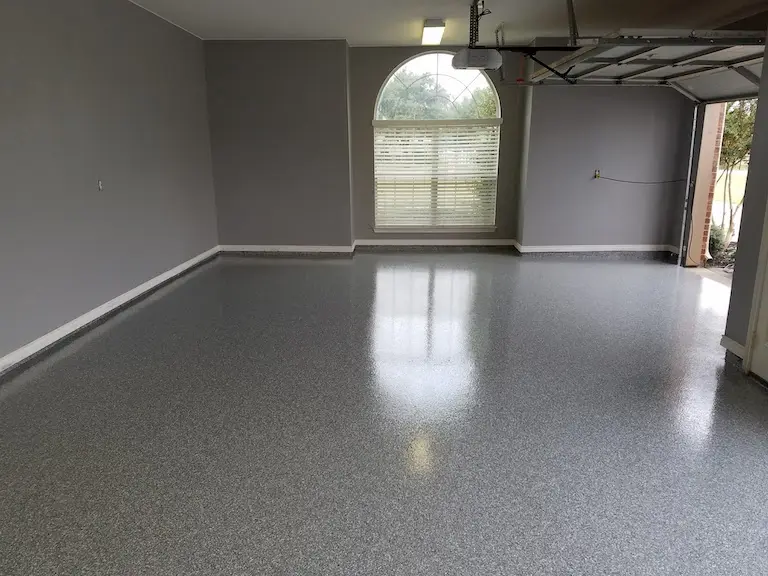
These two rooms fail paint more often than anywhere else in a house, and for the same underlying reason: moisture that nobody addressed first.
Basements: find the water before you paint
A basement wall that is damp, efflorescent, or peeling is not a painting problem yet. Paint applied over active moisture fails, and it fails faster than the previous coat did because the new film traps what the old one was letting out.
Look for:
- Efflorescence: a white crystalline powder on masonry. That is dissolved salt left behind by water moving through the wall. It has to be removed and the source addressed.
- Peeling in patches rather than uniformly, usually low on the wall.
- A musty smell that persists with the windows open.
- Staining at the base of the wall or along the floor joint.
The causes are almost always outside: gutters discharging against the foundation, grade sloping toward the house, or a downspout that ends six inches from the wall. Those are cheap to fix relative to repainting a basement twice.
Then: masonry wants a breathable coating, not an impermeable one. Sealing a damp wall with a film that cannot let vapour through pushes the moisture sideways and up, and it comes out somewhere else.
Basement walls that are genuinely dry
These paint straightforwardly. Masonry primer, then a coating rated for masonry. Light colors make a substantial difference to how usable the space feels, since basements rarely have enough light.
Ceilings in an unfinished basement are often better sprayed a single dark colour. It makes joists, ducts and wiring recede visually far more effectively than white does.
Garage walls
Straightforward drywall or block, with one difference: garages get knocked into. Use a higher sheen than you would inside (satin or semi-gloss) so it can be washed and takes contact.
Garage floors
This is the one that disappoints people most, because the common products underperform expectations.
Concrete has to be prepared, not just cleaned. A garage floor carries oil, road salt, and tyre residue, and concrete is sealed from the factory more often than people realise. Coating over any of that is why garage floor paint peels in sheets under the tyres within a season.
Preparation means degreasing, then etching or mechanically grinding the surface to open it up. That step is most of the labor and it is what the cheap kits skip.
Moisture matters here too. A slab on grade with no vapour barrier under it pushes moisture up continuously, and no coating survives that. The test is simple: tape a square of plastic sheeting tightly to the floor and leave it a day or two. Condensation underneath means the slab is wet, and coating it is money spent to watch it fail.
Hot tyre pickup is the specific failure mode: warm tyres bond to the coating and lift it when the car is moved. It is a preparation and product problem, not bad luck.
Concrete coating is not among the nine services we offer, so on a garage floor we will tell you what you are dealing with rather than sell you the job. The walls, ceiling, and any carpentry around the door we do handle.
Planning a painting project?
Book a professional, no-pressure consultation with Genesis Pro Painting.
Schedule a Consultation